Improving hygiene at school

In Honduras, water is life. With increased drought in the region, accessing water is increasingly difficult. Many families, usually the women, spend a good portion of the day getting water so they can cook and clean. But what happens when children are at school? Where does water for cleaning, bathrooms, and hygiene in schools come from if there is no water infrastructure in the community?

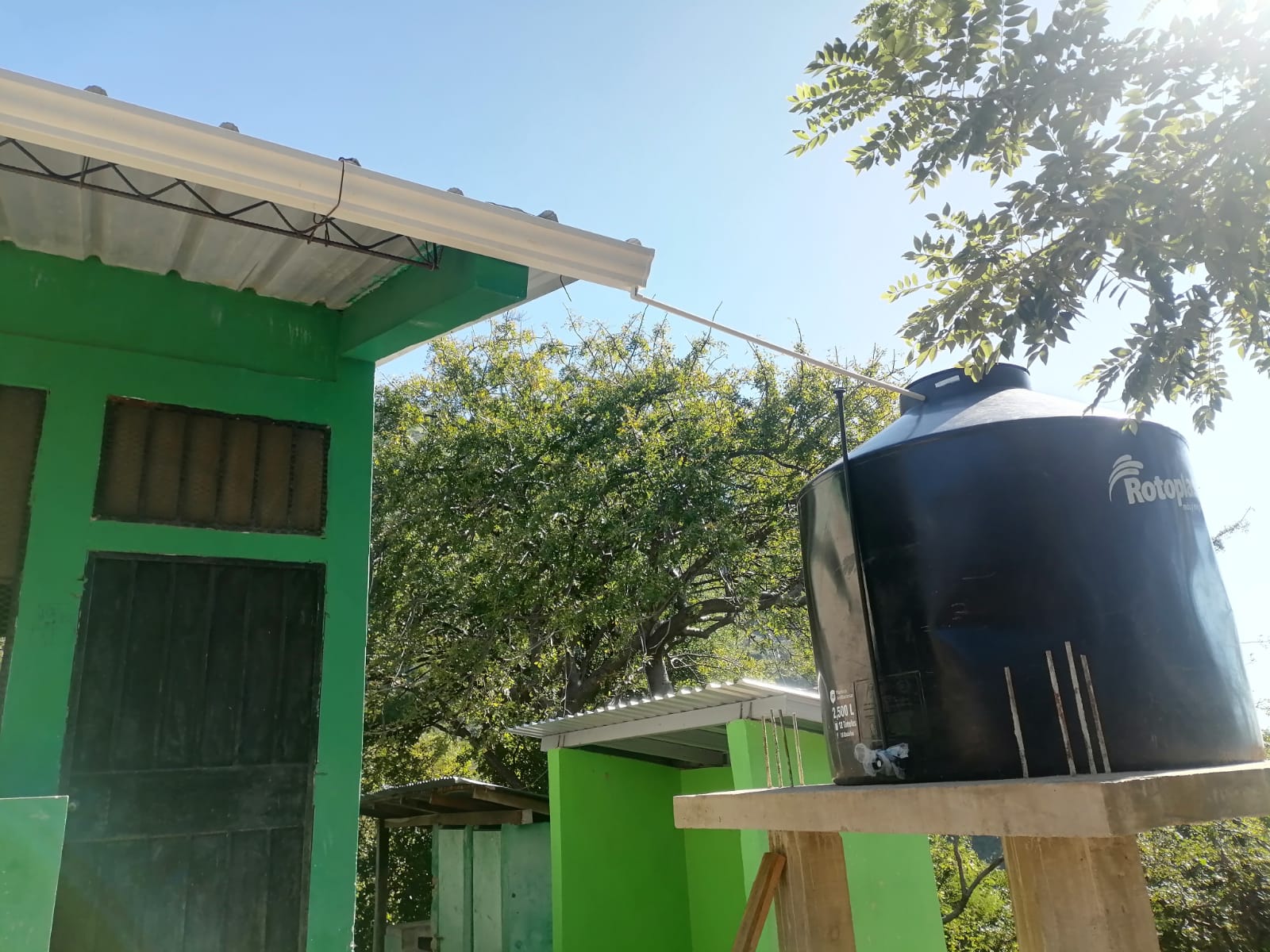
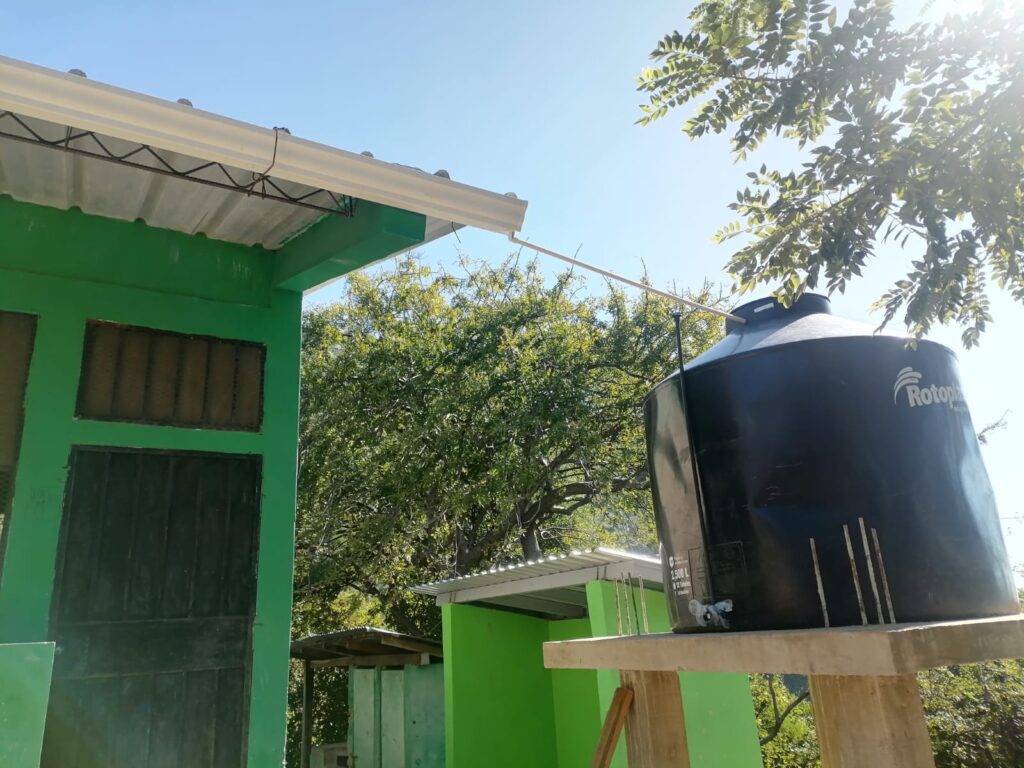
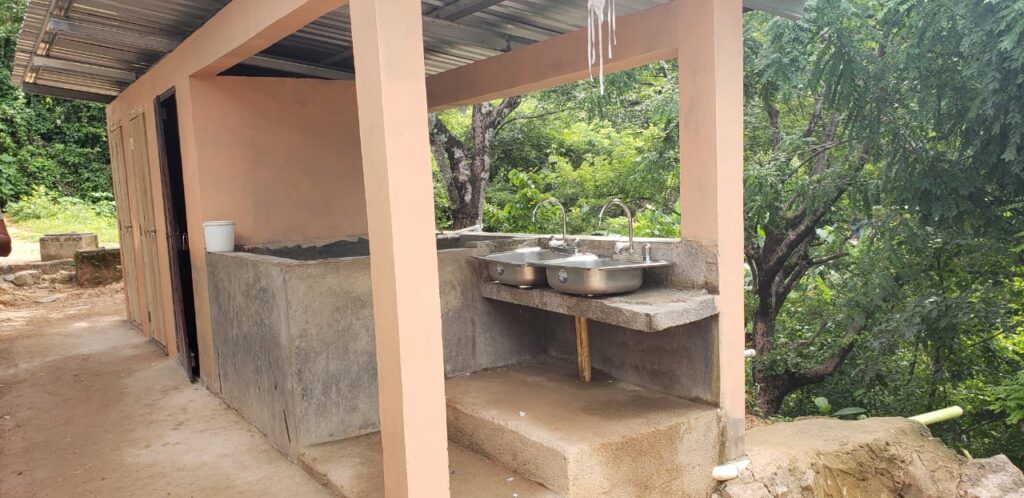
This type of wash station with bathrooms beside is quite common in Honduras.

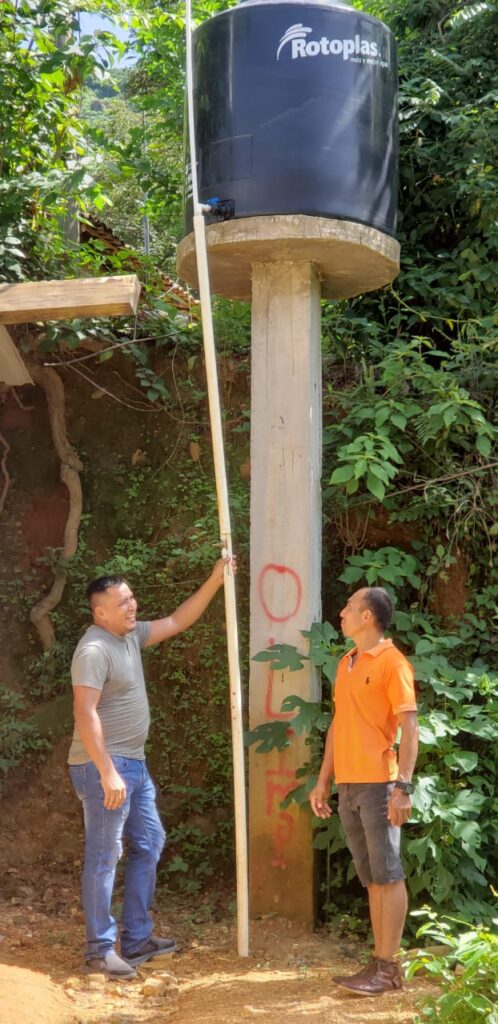
In the community of La Chaparral, Vecinos Honduras worked with community organizations such as the Board of Trustees, School Government, teachers and the Parents’ Association to figure out a solution to poor water access and limited hygiene options at the “Juan Lindo” Basic Education Center. Working together they were able to install a rainwater harvesting tank to store water, and they put in sinks and 2 toilets, as well as improving the condition of the existing washrooms by installing a ceramic floor and new wooden doors.

This small initiative benefited 74 girls, 52 boys and 8 teachers.

Water Tank Installation in El Chaparral

This activity was one of many activities that World Neighbours Canada supported in Honduras through Vecinos Honduras. Other activities we supported this year included community capacity building in the community of Langue, a new community where Vecinos Honduras is working. Many workshops were held regarding seed saving, how to advocate for water, seed, and health rights, training for young entrepreneurs, community clean ups, as well as financial literacy for micro credit unions, farmer’s collectives, and entrepreneurs.

World Neighbours Canada talk in Vancouver

Calling all World Neighbours Canada supporters in the lower mainland! World Neighbours Canada would like to invite you to a live talk by Vecinos Honduras Director, Carlos Vijil on February 29th at 6:30pm.

For more information and to register visit https://www.bccic.ca/event/climate-change-and-conflict-in-honduras/.

This event is co-hosted by BCCIC and World Neighbours Canada. It is delivered with support from the Government of Canada and the Inter-Council Network’s Spur Change program.


Thank you for your support in 2023!

Just a quick note of thanks for all your support over the past year. It has been a busy year for us supporting our partners around the world. Each country has their own unique challenges and solutions.

All of this good work has been accomplished because a few hundred Canadians like you decided that they were not only grateful for the food, water and safety they enjoy—they were also determined to do what they could to help people who are less fortunate. Thank you for your support! It has made a huge difference to the lives of thousands of people.

Please continue to support World Neighbours Canada and its partner organizations to the extent you are able. I urge you to give generously to help us continue our fight against poverty and injustice.

If you want to receive a tax receipt for the 2023 year, you have only a few more days to donate. You can donate here: DONATE or click on the link at the top of the page. Please consider donating monthly.

All the best for 2024!

The World Neighbours Canada Board and Volunteers.

Empowering rural women in Burkina Faso – Video

We are very proud of a recent project that was completed in Burkina Faso by our partner APDC. The project was funded by a grant World Neighbours Canada obtained from the Fund for Innovation and Transformation (FIT). FIT is a program funded by Global Affairs Canada. After project completion, FIT provided additional funding to provide training and support for APDC to produce a video about the project to allow World Neighbours Canada to share the results of the project with Canadians, and also with other villages in Burkina Faso.

Rather than tell you about the project in detail, we thought we would share the video instead so you can hear the process and results from the participants themselves.

The video is from on our Youtube channel. You can see it here:

About the project briefly:

Following discussions with women in the rural Eastern region of Burkina Faso, APDC implemented activities with 110 women to allow each woman to set up and manage a household sheep-fattening enterprise. APDC provided training in basic bookkeeping, techniques in the care of the animals, how to choose an animal at the local livestock market, and entrepreneurial training – the traits of a successful business person. A key element of the project was engaging family members, and their embrace of the project was one of the highlights.

About APDC:

The full name of the partner organization is Association d’Appui à la Promotion du Développement durable des Communautés défavorisés. It is a small rural development organization in eastern Burkina Faso that World Neighbours Canada has supported, in a variety of ways, since 2009.

New research reveals extreme fluctuations between drought and flooding

By Bruce Petch, Volunteer Executive Director, World Neighbours Canada

Research findings released by the UK charity WaterAid describe how some dry regions of the world, including parts of Burkina Faso, are subject to a “whiplash” of extreme climate pressures. Periods of drought are followed by devastating floods. The research was done in partnership with the University of Bristol and Cardiff University (https://www.bristol.ac.uk/news/2023/november/flooding-and-drought.html).

The research is consistent with the experience of people living in the Eastern Region of Burkina Faso. World Neighbours Canada’s partner in the country, APDC, has often reported the seemingly contradictory observations that crops suffered from drought during the growing season, but severe flooding damaged the bunds in rice fields. APDC has been working with farmers to adapt to the changing climate. One strategy is to build more rice fields in slightly low-lying areas (the terrain is quite flat). If floodwaters can be controlled, rainfed rice production has the advantage of being less reliant on the distribution of rainfall over the growing season. Another strategy is to reduce reliance on field crops by supporting livestock production, market vegetables (where wells can provide water) and processing of agricultural products such as sesame.

Unfortunately, APDC’s work is hampered by a violent insurgency in the country that has caused many rural people to leave their homes and farms and seek refuge in towns where the army is better able to maintain security.

Thank you Lydia

Lydia presenting to Canadian students.WNC recently welcomed to B.C.: Lydia Tapsoba, a Gender Consultant from Burkino Faso .  Lydia has worked extensively with our local burkinabe partner, APDC.

In one day, Lydia completed 3 presentations to high school students and the general public; and travelled from Kamloops, to Oliver and on to Osoyoos, B.C. In between the presentations, Lydia found time to touch snow ( for the first time ever!), make a snowball, putt a few golf balls and dip her toes in Osoyoos Lake.

Impact Story – Burkina Faso

Suzane and Blandine with Rebeka, APDC coordinator – 2 women who purchased the sheep entirely on their own.

The impact of poverty is complex. Local and international politics, climate change, food insecurity, and culture are just a few of the influencing factors. This makes implementing development projects difficult as there are many factors creating the situation. Secondly, it is almost impossible to anticipate all the outcomes of these projects. That is why the Fund for Innovation and Transformation (FIT) was created. It allowed organizations to study innovative approaches. World Neighbours Canada was lucky enough to receive funding for their partner in Burkina Faso, Association d’Appui à la Promotion du Développement Durable des Communautés (APDC), to test an innovative solution aimed at increasing women’s full and equitable economic participation and empowerment in both household and the livestock smallholder sector.

The following impact story, posted on the FIT website, gives a sample of the different ways the program impacted the community, and one couple in particular. Some of the ways were expected, while some were pleasantly unexpected.

To read the article please visit: Impact Story

Visiting Honduras – School Hygiene

Dileyla Funez displaying the new school latrines.

One of the small projects World Neighbours Canada (WNC) supported over the past couple years was providing materials for latrines, water collection and hygienic supports for schools in communities around Concepcion de Maria, Choleteca.

As a result of the Covid-19 epidemic the government of Honduras changed the requirements for schools in Honduras to have cement floors, latrines and water for cleaning purposes. This was to ensure hygienic conditions. Unfortunately, these requirements were not supported with funds and many schools could not open.

Dileyla Funez, with a parent volunteer demonstrate the water collection system.

In the community of Majada we visited one of these schools that we supported. It is a one room kindergarten school that used to have a dirt floor and no latrine. Now it has a new cement floor, a water collection cistern, and two toilets. WNC provided the materials but all the work, including carrying the materials the two kilometres from the road, was provided by parent volunteers. Vecinos Honduras provided the technical support.

Children dancing on their new clean floor. The previous floor was dirt and would either get muddy or dusty.

We were treated to many enthusiastic children who, along with their dynamic teacher Dileyla Funez, entertained us with song and dance. We got the sense that the dancing was more for the children than for us, but it was wonderful to see the joy and exuberance of the children, and the pride of the parents.

In total, 76 girls and 69 boys from four (4) educational centres in the communities La Majada, La Plomosa, El Peñón #2 and El Peñón #1 will have improved health conditions as a result of the construction of latrines and the installation of water storage tanks to harvest rainwater from the roofs.

Seventy-six parents were involved on the installation of the tanks at these educational centres by carrying materials, providing unskilled hand labour and gaining awareness about creating healthier environments for boys and girls.

This February, World Neighbours Canada (WNC) board members Gabriel Newman and Judy Gray along with WNC volunteer Peter Gray visited Honduras to see the work that was being done by our partners there, Vecinos Honduras. They will be sharing stories and information that they have gathered over the next few months. Write up by Gabriel Newman. Photos by Judy Gray.

Updated Burkina Faso page with videos

World Neighbours Canada has updated the information on the Burkina Faso page of their website as our partner, APDC, has been very busy with a number of new projects. We encourage you to visit and see what has been happening.

Visit the Burkino Faso Page.

We especially encourage you to check out the slideshows on the left hand side of the page. These photos have been taken by one of our directors, Judy Gray, and the APDC staff.

Here is a taste of what they look like. This is titled “Activities.”

Visiting Honduras – Micro Credit Unions

A few members of Empresa Campesino Union and Esfuerzo Collective.

In Azabache, we met with the Empresa Campesino Union and Esfuerzo Collective. This micro credit organization was created in order for the

The meeting has begun.

members to be able to receive small loans. As individual farmers it is almost impossible to receive a loan from a bank. Most of the loans that are needed are actually quite small. They are often in order to buy food to help the families get through the dry season when their supplies run out. Sometimes those loans are for home improvements, farm upgrades or business needs.

As an organization they were able to receive an interest free loan from Vecinos Honduras (with the support of Groundswell International). Members could then borrow from that amount. Men pay 2% interest and women pay 1%. The more money they borrow and pay back the greater their share of the profits. Profits stay in the organization. So far, they have paid back their original loan and now have enough money in the bank to fulfill future loans.

This organization was created informally about 5-6 years ago as part of VH’s holistic approach to community development. In the last year and a half, they have become a legal entity, which is a complicated and bureaucratic process that requires ongoing administration and oversight. This was done to ensure the future of the initiative. World Neighbours Canada has been supporting the training of the local

Yessica has been involved in many Vecinos Honduras programs over the years. She in on the health board, a mother guide, and her business making plantain chips now has a number of employees and she is now growing her own plantains.

volunteers to ensure it satisfies its legal requirements.

It was noted that many of the women present had been involved in other Vecinos Honduras initiatives over the past twelve years. One woman expressed that while they would like to keep working with Vecinos Honduras and would like them to stay in the community, they also know that they have the skills and dedication to carry one, not just for themselves but for the entire community.

This February, World Neighbours Canada (WNC) board members Gabriel Newman and Judy Gray along with WNC volunteer Peter Gray visited Honduras to see the work that was being done by our partners there, Vecinos Honduras. They will be sharing stories and information that they have gathered over the next few months. Write up by Gabriel Newman. Photos by Judy Gray.

These women, along with being members of this collective were also mother guides and monitors in the maternal child health program.

World Neighbours Canada • Box 1771, Oliver, B.C., Canada • V0H 1T0
250-498-1713 • info@worldneighbours.ca
Federally registered charity BN 89212 8646 RR 0001