information from Balvina Amador – project coordinator for Vecinos Honduras; posted by Judy Gray
ROMELIA CÁRDENAS, Guide Mother with Vecinos Honduras
We are happy to have received information from Balvina Amador, project coordinator with Vecinos Honduras, our partner NGO in Honduras. He has provided us with photos and key information about the individuals who are working at the grassroots level to model and support villagers who wish to improve their lives. Without these local leaders, implementation of new technologies and ideas would be difficult to achieve. Our project partners are also benefitting from the financial support provided by Global Affairs Canada through our Maternal Child Health grant.
Here is our first bio:
Romelia is a 54 year old mother and community leader living in San Jose where she is dedicated to running her home. From 2010-2014 she worked in community development with the support of World Vision. In 2014 she met a staff member of Vecinos Honduras and in 2015 she began receiving training in basic sanitation, food preparation, healthy eating, stove improvements, child nutrition and livestock management. In 2016 she integrated herself as a volunteer Guide Mother in her community and since then has been ensuring that the children in her community are growing and developing adequately. Romelia attended school until 6th grade and what she enjoys most is to care for the children of her friends and neighbours. She has worked in directive positions for groups such as the Society of Family Parents.
As the youngest member on the WNC Board of Directors, I had the unique opportunity to explore the historical roots of our community partnership in Ramechhap, Nepal during a short visit to the country in early January 2017.
Mrs. Durga Ghimire and I sharing 28 years of partnership between WNC and TSS.
This year, we are celebrating 28 years of partnership with Tamakoshi Sewa Samiti (TSS is our partner organization in Nepal). TSS was established in 1984 by the late Mr. Jagadish Ghimire and Mrs. Durga Ghimire. Throughout the years, I have had the pleasure of reflecting back on the early days of the organization through stories that were shared by individuals who have been part of the movement since the 1980s, such as Suresh Shrestha (current program coordinator) and Dr. Suman Karmacharya (current physician at TSS hospital). I remember sitting in the TSS courtyard and following the descriptive narrative of what the buildings and facilities looked like 10, 15, and 20 years ago. Often, I have had the honour of hearing about the Ghimire family, the family’s vision and commitment that inspired the creation of TSS and how their roots in social justice created a community-based foundation for everyone to build from.
This visit, I had the honour of meeting with Mrs. Durga Ghimire and her son, Himal Ghimire. It was truly a unique experience to learn about their journey with social justice, literature, and advocacy in regards to Ramechhap and also at the national level. Mrs. Ghimire is a renowned activist for women’s rights, safe migration and human trafficking. She founded Agroforestry, Basic health and Cooperative Nepal (ABC Nepal), which is an organization that is grounded in advocating for the rights of women and dismantling human trafficking practices. Further, the late Mr. Jagadish Ghimire is remembered by the nation for his great contributions to Nepal’s literature, his lifelong commitment to activism and grassroots planning, and his political contributions. On this occasion, we sat, reflecting back on TSS, sharing a meal together, and fostering a relationship that started 28 years ago by folks at World Neighbours Canada, some who we are still honoured to have on our Board, and others whom we miss dearly.
by Russell Work and Dale Dodge, posted by Judy Gray
It was a Ho Ho Ho, Merry Christmas for all concerned. The Oliver Rotary Club was pleased to be able to make a second donation to World Neighbours Canada in the amount of $4000 for their projects in Nepal. President Jennifer Roussel and International Director, Russell Work were on hand to present the cheque to Director, Dale Dodge.
As Dale Dodge, director with WNC stated: “The money is very welcome and will be put towards the Global Affairs Canada (GAC) Maternal-Child Health project presently under way in Nepal. WNC and their partner Tamakoshi Sewa Samiti (TSS) are working with villagers in Nepal to install 21 gravity fed water systems and 4200 sealed, hygienic toilets in the next 4 years. The project is now into its second year and, despite a huge earthquake in Nepal two years ago, things are moving along well.”
posted by Judy Gray, with quotes from our partners – Vecinos Honduras and APDC
Our partner organizations, Vecinos Honduras and APDC from Burkina Faso have recently sent well-wishes for a prosperous new year and expressed thanks for the support they have received from World Neighbours Canada and Global Affairs Canada. The directors of World Neighbours Canada pass on those wishes and gratitude to all our supporters. We are hoping for peaceful conditions throughout the coming year in all the areas where we are working with people to alleviate poverty. Here are the messages from our partners.
¡Que las fiestas de navidad sean propicias para fortalecer nuestro compromiso por un mundo mejor e iniciar el 2017 con renovadas energías y esperanzas!
~ miembros directivos, personal técnico y administrativo de Vecinos Honduras
“Nous adressons des voeux de santé, de progrès, de paix et de succès à WNCanada et au Gouvernement Canadien à travers votre Institution. Toute notre vive gratitude à l’égard de vos multiples efforts pour nous soutenir, s’exprime également à travers ces voeux.”
~ Charles Tankoano et toute l’équipe de APDC, ainsi que les communautés de Fada
by Vera Radyo, Executive Director of the Kenoli Foundation and a World Neighbours Canada volunteer; photos by Ken Phillips; posted by Judy Gray
Improved stoves make a world of difference for women, their families and the environment.
Over the years, we have seen dramatic improvements in the lives of the people in the original 10 communities of the Michael Newman Program located in the El Guano area of the municipality of Danli.
As a result of an agrarian reform process, some landless farmers “campesinos” were granted land in the remote mountain areas of the Danli. In 2007, when Vecinos Honduras came there, the community leaders stated that food insecurity was a huge problem with an average of 90 days a year when families had no food and were forced to borrow funds at exorbitant interest rates to feed their families. Thus, not only were they extremely poor, but they were in debt!
This plantain harvest will help feed the family.
The reality for these communities has changed dramatically since then. They are now food secure. The families have learned how to grow organic corn, beans, coffee, vegetables and fruits. Their children are healthier and better nourished. Women cook on improved stoves, no longer inhale the smoke from cooking over open fires and they have made many household improvements. The families no longer live in isolation from one another, but have formed coffee cooperatives and micro-businesses.
Because they live in remote mountainous communities, they are easily forgotten. However, they have learned how to advocate for themselves and have received support from the local municipality in the way of water and sanitation, road improvements, construction of a training center and more. Most importantly, community leaders have been trained as agents of change to ensure that the development is sustained. These communities will never regress to the old ways!

These children are learning a marketable skill — making beautiful baskets!
The Vecinos Honduras model is unique. The staff of the project live in the rural and remote communities in which they work. This model has been very successful and for the past few years, the staff of the Michael Newman Program have shifted the focus of their work to another 7 villages in the mountains of Azabache, where they are already seeing important changes in the lives of the communities.
NOTE: Michael Newman of World Neighbours Canada supported the Vecinos Honduras programs for over 20 years and passed away in 2013. The program was named in his honour. World Neighbours Canada is pleased to be able to support the expansion of this project into a new area, Valle, in part due to grant support from the Canadian Government as part of a Maternal, Newborn Child Health initiative that WNC received. Further program expansion in Azabache is not possible at this time due to insecurity as violent crime is widespread in the country because of the drug trade and ineffective policing.
posted by Judy Gray, with information from Libby Denbigh
The Denbigh family in Salleni, Nepal – Libby, our newest Board member, wearing a white Tilley hat.
My name is Libby, short for Elizabeth, but nobody calls me that except the bank. My late husband, David Denbigh, was a member of the board of World Neighbours for several years. He passed away suddenly last December and I am honoured to be asked to take his place on the board. I don’t expect to be able to fill his shoes, (they were size eleven, after all) but I will do what I can to help this really important organization. I have seen first hand what money from WNC has accomplished in Nepal as I have been there twice. Our initial interest was spurred by our younger daughter’s death in 2006. Her last wish was that we should find an NGO that worked with the villagers of Nepal. We chose World Neighbours because all of the board are unpaid volunteers. All the money donated goes to fund new water systems in the rural area of Ramechhap in Nepal, or to projects in Honduras and Burkina Faso. We have been supporters ever since. I am a retired primary teacher. I have three children and four grandchildren and I enjoy camping with them in the summer and skiing in the winter. Originally a farm girl from Manitoba, I have lived and worked in Kamloops since 1970. I look forward to serving on the board of WNC for as long as I can be of assistance.
World Neighbours Canada is a member of the BC Council for International Cooperation (BCCIC), a network of organizations working in international development. I attended the annual general meeting of BCCIC in Vancouver in mid-September. It was a great opportunity to meet with other BC organizations who are also engaged in the alleviation of poverty around the world. BCCIC has provided a number of very useful workshops over the past year, with topics such as project monitoring and donor stewardship. The network also fosters connections with Global Affairs Canada, and a current employee and two retired employees from this branch of the federal government attended the meeting. They were able to provide insights into the functioning of this sector of our government. Lastly, BCCIC is a useful link to “the big picture” of international development. A current focus of attention is the Sustainable Development Goals adopted by the United Nations, a lofty set of goals intended to make the world a better place for everyone by 2030.
a short excerpt from, “Sustainable Community Development” written by Navjot Gill as a reflection of her 2016 field visits in Ramechhap, Nepal ]
I had the opportunity to accompany the TSS (Tamakoshi Sewa Samiti – our partner NGO in Nepal) team to the district of Hilidevi for an initial community-wide engagement visit. Here, TSS will support the construction of household toilets. This work will be funded by the Global Affairs Canada grant in Maternal, Newborn and Child Health. The community of Hilidevi faces many challenges in health care and development. First, it is extremely isolated. It is a 5-hour drive from Manthli and roads are often closed due to the weather. Second, the community lacks basic necessities. There is no access to electricity and most people have no access to water. Lastly, the village does not have accessible health care, though there is a health post in the district headquarters. With so many challenges, where does development even begin?
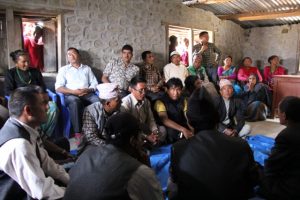
The community-wide meeting in Hilidevi gave individuals, families, and service providers an opportunity to discuss some of these challenges. In total, there were 8 TSS personnel and 55 community members, ranging from children, mothers, elders, teachers, health care workers, political leaders and female community health volunteers. TSS project coordinator and board member presented their invitation for collaboratively building household toilets in the district. This was followed by an invitation for community members to discuss their experiences of health care. Themes that circulated the room were access to healthcare services, lack of accessibility due to their geographical location, the need to include and provide for those who cannot afford to build their own toilets, and an agreement that ODF (open defecation free) was a priority for the community. This participatory process ensures community buy-in, allows dialogue and discussion, and further gives community members, like the health services providers, an opportunity to discuss the importance of topics like household toilets in relation to infectious disease.
Board of Directors for WNC: (left to right) Judy Gray, Bruce Petch, Laurena Rehbein, Mary Doyle, Graem Nelson, Libby Denbigh, Dale Dodge and Nav Gill
The Annual General Meeting of WNC took place last weekend in Penticton B.C. As always, it was an intense, though very cordial meeting, with many items to cover. Much of the discussion centred on developments dealing with our Maternal Newborn Child Health grant from the federal government. Activities are underway in each of our three project countries; and our partner NGOs are very happy to know that funding will be secure for the next four years. Some Board members are experiencing a very sharp learning curve with respect to the documents required by the government!
We are also very happy to announce that Libby Denbigh has joined WNC Board. We’ll be profiling Libby soon on our website.
Content and Photos provided by Suresh Shrestha, Tamakoshi Sewa Samiti Compiled by Bruce Petch, World Neighbours Canada director
Completed tap stand
A gravity-fed water system was constructed in the village of Lahachhewar in the district of Ramechhap in Nepal, from March to June 2016. The work was done by the residents of the village (on their own time), with technical support and guidance from Tamakoshi Sewa Samiti (TSS, a Nepali NGO based in Ramechhap). Funding was provided by World Neighbours Canada, which was supported by Global Affairs Canada, Kamloops West Rotary, Aldergrove Rotary and Oliver Rotary.World Neighbours Canada also continues to receive donations in Rachel Denbigh’s name for work in Nepal.This was the first water system installed under a new four-year project supported by Global Affairs Canada.
Reservoir construction
The Lahachhewar Water System will service 30 households with a population of 206 people – 120 female, 86 male, 81 children under 12. The water system consists of an intake at the source (a spring on the hillside, a concrete and stone storage tank below the source, a buried PVC water line running down the slope to the village, and 6 public tap stands.
The construction of gravity fed water systems requires that reservoirs be built at some point between the water source being accessed, and the water stand pipes in the villages being serviced.
The reservoirs are typically 5 cubic metres in size, and will hold 5000 litres of water. The reservoirs are always built in a location such that a break would not cause a flooding of any nearby residences. In the 27 years, including 2015 when there was a major earthquake in Ramechhap and nearly 90% of the homes in the district were damaged, a TSS built water reservoir has never failed. Only minor damage was sustained to a few water systems in the 2015 earthquake.
Community Participation, Technical Guidance and Summary of Environmental Impacts
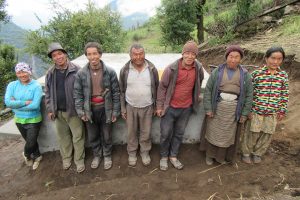
Water User Committee members
The Water User Committee, with help from the TSS technical people, plan all aspects of the water system. They decide the location of the intake, the route of the pipe, the size and location of the water reservoir, and the location of the tap stands in the village.
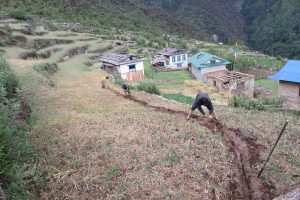
Digging the trench for the waterline
The water users – the villagers – do all of the physical work. They transport materials, they dig and backfill the ditch for the pipe, they help build the water reservoir, they help construct the tap stands. This is all done with guidance of the TSS technicians.
The cement work is done by people trained by TSS over the years. These people may still live in their original village, but will travel to nearby locations to do the cement work and to train others to do similar work. The Government Engineer is notified when the work is done and will do a final inspection.
At all stages of the project, environmental considerations are identified and assessed. The water source is always fenced off so that animals cannot access the source. Ditches are always filled in such that there is no evidence of ground disturbance. Reservoirs are always placed in areas such that if they were to fail, there would not be any damage to structures below them. Tap stands are always made of cement, with cement catchment areas below to prevent erosion of the immediate area.
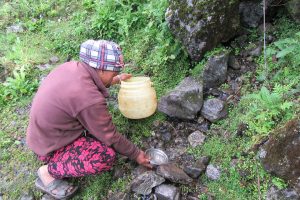
traditional water sourcetraditional means of obtaining watercompleted tap stand
The farthest tap stand from the water source is approximately 2 kilometres. It is estimated that the women using that tap stand will save 3-4 hours per day in carrying time. What an important change the completion of this water system must make in the lives of these women!



 It was a Ho Ho Ho, Merry Christmas for all concerned. The Oliver Rotary Club was pleased to be able to make a second donation to World Neighbours Canada in the amount of $4000 for their projects in Nepal. President Jennifer Roussel and International Director, Russell Work were on hand to present the cheque to Director, Dale Dodge.




 I had the opportunity to accompany the TSS (Tamakoshi Sewa Samiti – our partner NGO in Nepal) team to the district of Hilidevi for an initial community-wide engagement visit. Here, TSS will support the construction of household toilets. This work will be funded by the Global Affairs Canada grant in Maternal, Newborn and Child Health. The community of Hilidevi faces many challenges in health care and development. First, it is extremely isolated. It is a 5-hour drive from Manthli and roads are often closed due to the weather. Second, the community lacks basic necessities. There is no access to electricity and most people have no access to water. Lastly, the village does not have accessible health care, though there is a health post in the district headquarters. With so many challenges, where does development even begin?